
How to Search Cases by Name
Pickett County offers no online form for a trial-case name search. So call the clerk who keeps the division's docket. For Circuit, Criminal, or General Sessions matters, reach Circuit Court Clerk Danny Huddleston at 1 Courthouse Square, Suite 100, Byrdstown. His number is 931-864-3958. Chancery and probate files sit with Clerk and Master Leana Neal, Suite 203, 931-864-3359.
- Identify the court from a citation, summons, notice, or prior order.
- Give the complete case style or full first and last names, including alternate spellings.
- Add the filing year, case type, charge, citation date, issuing agency, or known setting.
- Ask the clerk to confirm the case number and whether the file is public.
- Request the docket plus any specific pleading, order, judgment, or certified copy needed.
| Field | Type | Required | Notes |
|---|---|---|---|
| Party or case style | Text | Yes if number unknown | Supply full names and spelling variants. |
| Court | Division | Strongly preferred | Circuit, Criminal, General Sessions, Chancery, probate, or juvenile. |
| Year or range | Date | No | A narrow range helps locate paper and legacy files. |
| Case context | Text | No | Type, charge, citation date, agency, or known setting. |
Pickett's Search Starts Offline
The Tennessee Public Court Records System is a TnCIS menu of participating counties, and Pickett County does not appear on it. Treat it as a statewide tool, not a Pickett portal. An empty search there proves nothing about whether a Pickett case exists or is public.
Local fallback chain: call the clerk, visit the proper courthouse suite, ask about a public inspection, submit a focused written request for copies, and inquire whether an older file is in a paper index, bound volume, microfilm, or archive.
The county officials directory lists both clerk contacts. The county has not announced a public terminal for self-service searching, so phone ahead before you drive over. Mail, fax, and email requests may work under each office's instructions and the county public-records policy.
How to Search by Case Number
A case number is your best search key in Pickett County. No official local number format has been published. Use the exact identifier exactly as the clerk printed it. Keep every letter, hyphen, year segment, and leading zero. Do not reshape it into a guessed pattern like YYYY-CV-#####; that string is only an illustration, not a verified Pickett format. If nothing matches, ask good questions. Does the number belong to another division? Did a General Sessions matter later get a Criminal Court number? Did an appeal get its own appellate identifier? Hang on to both the originating number and the appellate one. They link related records, but they do not search the same database.
Pickett Court Determines the Clerk
The court decides which clerk holds the file. Circuit Court keeps general-jurisdiction civil work and matters assigned by law. Criminal Court handles felonies inside the Thirteenth Judicial District structure. General Sessions takes limited civil cases, misdemeanors and preliminary criminal matters. It also handles traffic work under Tennessee law. Chancery, through the Clerk and Master, covers equity matters and local probate. Juvenile files sit behind restricted-access rules.
Danny Huddleston, Circuit Court Clerk: Circuit, Criminal, and principal General Sessions court contact.
Leana Neal, Clerk and Master: Chancery and probate records.
Tennessee appellate clerk system: appellate case history after the record reaches an appellate court.
Several Pickett County courts share one address, 1 Courthouse Square, so picking a clerk by location alone leads you wrong. Read the division printed on the document instead.
What a Case Search Shows
A clerk-confirmed match can open the docket header and the chronological register of events. No public Pickett trial sample shows the exact local display, so ask the clerk what you will see rather than assume it. Tennessee clerk guidance and local rules support these common record elements.
| Case number | The exact local identifier assigned by the clerk. |
|---|---|
| Style or parties | Plaintiff and defendant, petitioner and respondent, or State and defendant. |
| Court and type | The division and civil, criminal, probate, or other category. |
| Filed date and status | Initiation date and current procedural state when maintained. |
| History | Pleadings, citations, notices, hearings, motions, continuances, orders, and judgments in chronological order. |
| Settings | Date, time, courtroom, judge, and setting type when recorded. |
| Disposition | The entered result; request the signed judgment for exact legal terms. |
A docket is usually an index, not the whole file. Request the complaint, indictment, motion, order, judgment, exhibit, or certification separately. Pickett has not confirmed public online document images.
Appellate Searches Have Four Modes
Tennessee Public Case History gives you four official search modes. These are case number, case style, party name, and business or organization. Its reach runs across the Tennessee Supreme Court, Court of Appeals, and Court of Criminal Appeals. The AOC says coverage starts with cases whose appellate record was filed after September 1, 2006. Updates generally run through the prior business day. Permitted PDF documents may be linked. The search page presents those four modes on its face.
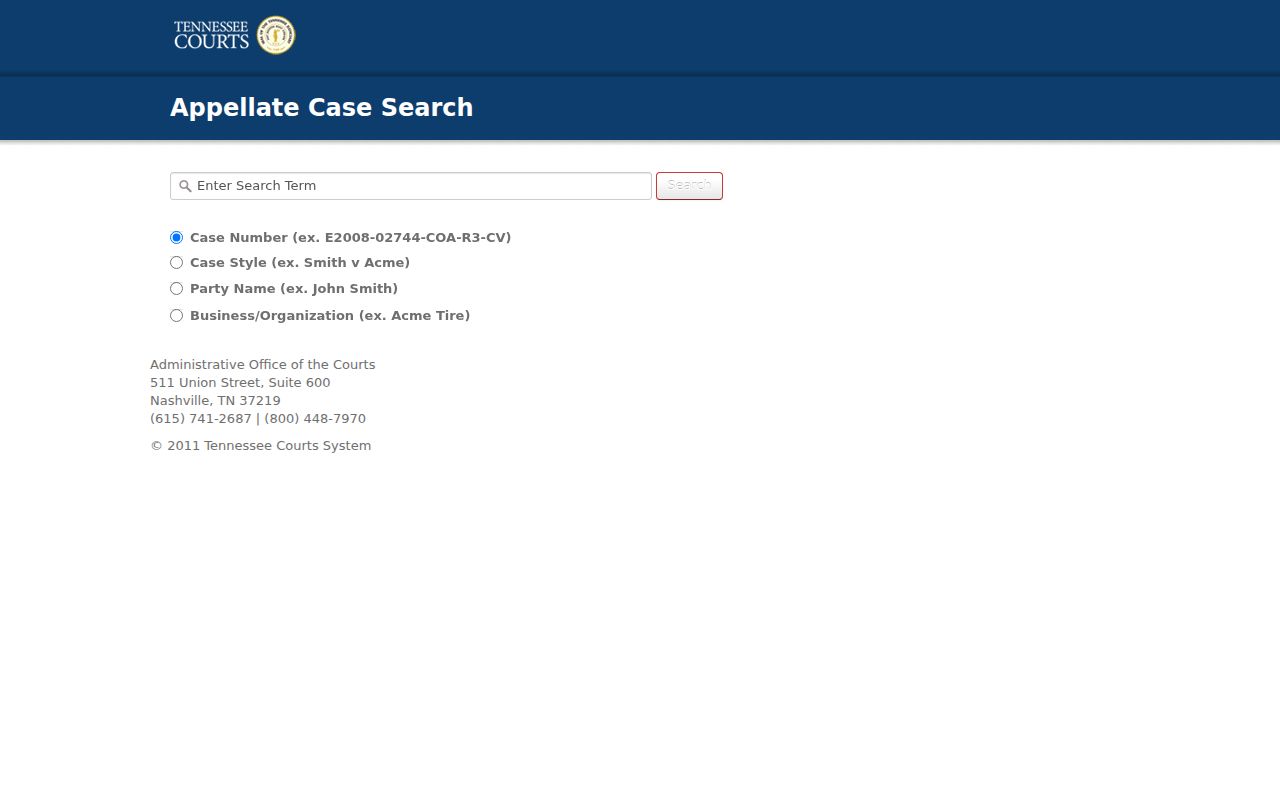
Type an appellate number exactly if you have it. If not, try the formal case style, a party, or an organization. Results can include the case overview, originating court and number, judge, attorneys, record filing, briefs, motions, submission, opinions, orders, mandate, and permitted PDFs. For the trial docket and trial-file documents, go back to the Pickett clerk.
Pickett Case Numbers Versus Appeals
A Tennessee appellate number can look like M2024-xxxxx-CCA-R3-CD. Its segments mark division, year and sequence, appellate court, rule, and case type. That published structure says nothing about Pickett County's local trial-number system. Enter a local number in Public Case History and you may get nothing. The appeal must exist and its record must be filed first. When you track a case across levels, keep a simple log. Note the originating court, local number, appellate court, appellate number, filing date, and current event. That habit stops you from reading an appellate decision date as a trial setting. It also keeps you from treating an appellate PDF list as the whole local file.
County vs Statewide Case Search
Pickett County gives you a clerk-based search process, not a public trial portal. Tennessee Public Case History reaches statewide, but only across the state appellate courts. It is not a database of ordinary county trial cases. The two channels answer different questions.
| Tennessee Public Case History | Pickett clerk search |
|---|---|
| Supreme Court, Court of Appeals, and Court of Criminal Appeals | Local Circuit, Criminal, General Sessions, Chancery, probate, or other held files |
| Online search by appellate number, style, party, or organization | Phone, counter, and focused request using local identifiers |
| Appellate procedural events and allowed PDFs | Original trial docket and requested public case documents |
| Coverage tied to appellate record filing after September 1, 2006 | Older and current local holdings subject to clerk custody and access rules |
The AOC search guidance backs up the appellate coverage and its currency. Verify any local name match against the case number and court. Tie any appellate match back to the originating Pickett County number.
When Pickett Results Do Not Match
A docket search in Pickett County can come up empty for plain reasons. Maybe the name is spelled differently in the file. The caption may be old. The case number might have changed at some point. Paper filings and slow indexing do the rest, since a new case may not show online right away. A blank result can also mean a sealed or expunged matter. That alone proves nothing, though. Work through the ordinary explanations first before assuming the court record is closed.
- Check the court name and every character of the number.
- Try the full formal case style and alternate spellings.
- Narrow the year range and identify the case type or issuing agency.
- Ask whether the matter moved between General Sessions and Criminal Court or received an appellate number.
- Ask whether the file is current, archived, on microfilm, sealed, redacted, or held by another office.
Old Pickett County court records raise a different question: where the file sits now versus who can certify it. The Tennessee State Library and Archives microfilm inventory helps you spot the right record series from years past. Certification, though, still runs through the present clerk, so confirm custody and the certified-copy steps there.
Restricted Cases and Access Rules
Tennessee Supreme Court Rule 34 makes court records open by default, but statutory confidentiality, court rules, protective orders, sealing orders, and judicial-function exceptions all carve out limits. Juvenile files and identities stay shielded. A sealed filing might leave only a bare docket entry while the paper itself stays out of reach. Expunged criminal entries drop from public view entirely.
Pickett County policy calls for redacting confidential information and honors specific record requests. Looking at open county records costs nothing. Copies run $0.15 per black-and-white page and $0.50 per color page, with an estimate and advance payment required above $5; ask about separate court certification fees. If the office cannot produce records promptly, it must respond in writing within seven business days by producing them, denying them with a legal basis, or stating how much time it needs.
A missing online result is not a sealing decision. Ask the custodian whether the case exists, which court holds it, and whether any restriction applies. If access is denied, request the legal basis and ask whether a redacted record can be released.