
Searching Pickett County Civil Dockets
Match the clerk to the court named on your summons, notice, pleading, or order. Circuit civil files sit with the Circuit Court Clerk. Danny Huddleston holds that office at 1 Courthouse Square, Suite 100, 931-864-3958. Chancery and probate-related files go to Clerk and Master Leana Neal, Suite 203, 931-864-3359. General Sessions takes limited civil work such as small claims and detainer matters. The courthouse can confirm local routing. The county offers no online civil docket search form. When you call, have the exact case number ready. Also have the plaintiff and defendant names, filing year, case style, case type, and any known judgment or setting date. Tennessee Public Case History comes in handy only once an appeal is involved.
- Read the notice and identify Circuit, Chancery, or General Sessions.
- Collect the case number, full style, filing year, and document needed.
- Call or visit the clerk that keeps that court's file.
- Ask to inspect the public docket or request a copy.
- Confirm certification, delivery method, and cost before payment.
Pickett Civil Courts Split Custody
Pickett County splits its civil work three ways. Circuit Court serves as the main general civil trial venue. Chancery handles equity, domestic-relations, and probate-related matters through the Clerk and Master. General Sessions takes the smaller, limited-jurisdiction claims. No official Pickett dollar threshold is published. Never choose a court by guessing at an amount. Ask which venue accepted the filing and route your docket search there.
| Court | Useful search clues | Custodian route |
|---|---|---|
| Circuit | Case number, parties, filing year, civil category | Circuit Court Clerk |
| Chancery | Style, estate name, hearing or order date | Clerk and Master |
| General Sessions | Summons number, parties, detainer or small-claim type | Confirm at local court counter |
| Appeal | Appeal number, style, party | Tennessee Public Case History |
One courthouse building does not mean one index or one keeper of the records. Getting the routing right the first time saves effort and avoids false "no record" answers.
Inside a Pickett Civil Docket
A civil docket opens with the complaint, petition, or other initiating paper. From there it can list summons issuance and return, an answer, a counterclaim, default activity, motions, notices, and hearings. Orders, trial, and judgment may follow. After judgment, expect entries for garnishment, execution, payment, satisfaction, or an appeal. Keep one caution in mind. An entry shows only that an event was recorded. It does not prove every fact asserted in a pleading is true.
| Header | Court, division, case number, filing date, style, judge, and status. |
|---|---|
| Parties | Plaintiff or petitioner, defendant or respondent, and counsel roles. |
| Register | Dated complaints, answers, motions, notices, orders, and judgments. |
| Settings | Date, time, place, judge, and hearing type when supplied. |
| Result | Judgment, settlement, default, dismissal, nonsuit, or transfer. |
When exact terms matter, ask for the signed order itself. The docket is an index and a timeline, not the full evidence file or a transcript.
Pickett Contract Cases Lead Filings
Contract and debt cases dominate the Pickett civil docket. The Tennessee AOC fiscal year 2024-25 Circuit report counted 19 Pickett County civil filings, and 15 of them involved contract, debt, or specific performance. The rest included one tort filing and one other domestic-relations filing. Across all categories, the report recorded 24 dispositions.
Those dispositions broke down as 10 dismissals, 5 uncontested or default results, 3 compromises without a hearing, 3 court-approved settlements, and 3 other results. Treat these numbers as activity counts rather than a roster of private cases. Some filings date from an earlier period. The report itself cautions that totals depend on data received before publication. For any single case, use the actual Pickett County civil docket. Then read the signed order.
Civil Case Types on the Docket
Pickett County Circuit dockets can hold contract, debt, tort, workers' compensation, and other matters. Each must fall within that court's authority. Chancery adds equity, property, domestic-relations, estate, and probate-related work. General Sessions may carry small claims along with eviction or detainer matters. Jurisdiction turns on Tennessee law and the action itself, never on a page label. Family and probate files deserve extra care. A case-level entry can be public. A child's information, protected report, account number, sealed exhibit, or confidential attachment may stay withheld or redacted. A settlement or default still generates docket entries and an order. No public trial transcript needs to exist. The Tennessee AOC Self-Help Center offers general small-claims and clerk-routing information. It is no substitute for advice on a specific case.
Pickett Chancery Session Rhythm
Thirteenth District Chancery rules set a distinctive calendar for Pickett County. Regular sessions begin on the third Mondays of March and September. Chambers hearings ordinarily take place Fridays in Cookeville at 10:00 a.m. Those fixed points do not mean every civil matter lands on them. A setting can arise in several ways. It may come by agreement after consulting the court, through clerk coordination for uncontested matters, by noticed motion, by court order, or at a docket setting. Attorneys ordinarily get at least 20 days' notice. That rule applies unless the setting falls on the first day of a session. Once set, written notice states the time and place. The clerk prepares the daily trial calendars. Because of these local practices, a generic state calendar or an old notice may not reflect the current Pickett County civil setting. Check the clerk and the filed notice.
Pickett Civil Docket Settings and Hearings
A setting on the Pickett County civil docket is a scheduled procedural event. It is not automatically a trial. Motion hearings take up requests for the court to act. Status and scheduling settings sort out the steps still to come. Even an uncontested hearing can call for proof and an order. A final hearing or trial is where the merits get decided. Always pair the setting type with the date, time, place, and judge.
Local Chancery rules set tight deadlines for these filings. In the stated circumstances, certain deadlines apply. Motion responses and certain reply briefs are due no later than 24 hours before the motion hearing. Proposed exhibits generally come due five days before a final hearing. Medical depositions come due seven days before. Those filings often generate docket entries ahead of the hearing itself. A continuance in a contested merits matter needs court leave and good cause. A mere request for delay never proves the date moved. Confirm the entered order and the revised setting with the clerk. Do that before relying on any new date.
Civil Requests That Save a Trip
A specific request helps the clerk pull the correct file. Give the court and the case number first. Add the full style, the filing year, the document title, and an approximate filing or hearing date. Say whether you want to inspect the record, get a plain copy, or need a certified copy. Probate requests should add the estate or decedent name. For General Sessions, include the summons number and the matter type.
Pickett County accepts requests in person and in writing by mail, email, or fax, subject to office direction. The office may ask for proof of Tennessee citizenship along with acceptable identification. Looking at open records is free. General copies run $0.15 per black-and-white page and $0.50 per color page. Estimates over $5 require advance payment. Certification is a separate charge the clerk must confirm. Depending on the office, you may pick records up. You may also receive them by mail after postage or get them electronically.
Pickett Civil Appeals Use State Search
A Pickett civil case has been appealed. Now the Tennessee Public Case History site becomes the tool that matters. It covers Pickett civil appeals before the Court of Appeals and the Supreme Court. Search by appellate number, style, party, or organization. Results may list the originating court, the trial judge and number, the record filing, and briefs. Oral argument or submission, the decision, the disposition, and permitted PDFs may appear as well.
Coverage extends to appeals with records filed after September 1, 2006. Remember that this appellate layout is not the local Circuit or Chancery docket. Track the appeal here. Then request the trial record from Pickett County itself. The wider Pickett County case lookup walks through searches by name and number.
The official civil-forms interface can help you spot General Sessions filing types. Its Tennessee court source shows the approved forms.
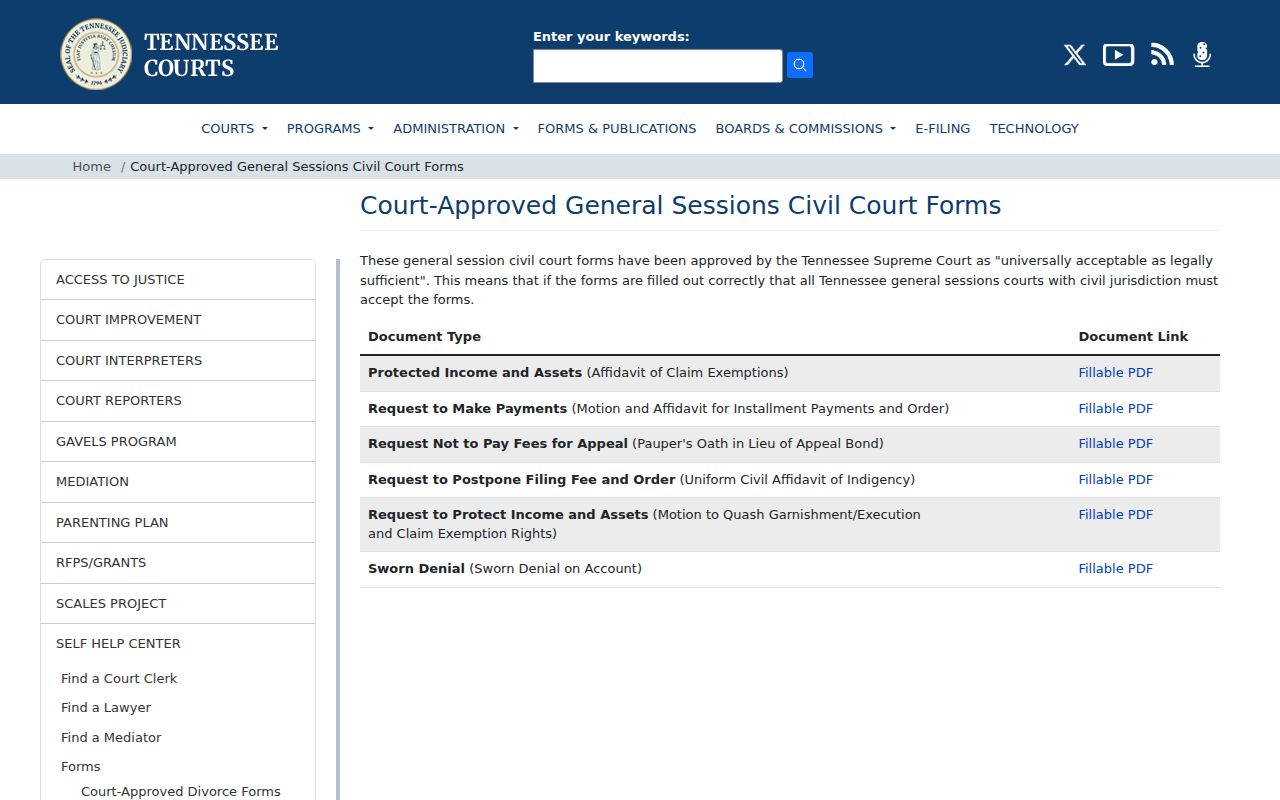
The form list helps sort out common lower-court filings, while the Pickett clerk confirms the right case and docket entry.
Pickett Civil Docket Access Rules
Tennessee Supreme Court Rule 34 leans toward public access to court records. That default bends only for statutes, other rules, protective orders, sealing orders, and judicial-function exceptions. Rule 1A sets the sealing standard for civil records. A serious and substantial interest must outweigh openness. No less restrictive method can be available. Even then, a public docket may keep a generic entry. The paper behind it stays sealed.
An empty online search does not mean a Pickett County civil file is sealed. Another clerk may hold it. It might exist only on paper or microfilm, or the county simply offers no portal. Ask the custodian whether the docket is public. Ask whether a redacted copy can be provided and what legal basis supports any denial.
Access authority: Tennessee Supreme Court Rule 34 governs court-record access and exceptions.
The Tennessee Public Records Act guidance explains specific requests and the seven-business-day response framework.