
Searching Pickett County Criminal Dockets
The county offers no online trial portal. Your first call is Circuit Court Clerk Danny Huddleston. He manages Criminal Court files and serves as the main General Sessions contact. Give the office the court, the defendant and State caption, the filing year, the charge, any known setting, and the case number. Lower-court matters need the citation number, citation date, and issuing agency too. Reach the clerk at 931-864-3958 or at 1 Courthouse Square, Suite 100, in Byrdstown. A written request can ask for copies. Tennessee Public Case History covers appellate courts only. So it is no substitute for a local search.
- Identify Criminal Court or General Sessions from the notice.
- Gather the case or citation number, names, year, and date.
- Call or visit the Circuit Court Clerk and ask for the public docket.
- Review charges, settings, orders, plea, and disposition.
- Request a plain or certified copy if needed.
Pickett Criminal Search Channels
The county officials directory lists the clerk's local contact details. At the counter, you may inspect any record the clerk marks as open. A quick phone call can confirm who holds the file. It can also confirm where it sits and the next setting before you drive over. Mail, fax, or email can carry a written request under county policy. That route is subject to office instructions.
Tennessee Public Case History becomes useful only when an appeal reaches the Court of Criminal Appeals or the Supreme Court. The public TnCIS county menu does not list Pickett. So treat it as no Pickett portal. An attorney may confirm a setting. The filed docket stays the official history.
Inside a Pickett Criminal Docket
A criminal docket is a timeline. Entries may name the court, case number, filing date, State and defendant caption, judge, charges, attorneys, bond events, hearings, motions, orders, plea, judgment, and later activity. Pickett County does not publish its exact trial number format. Have the clerk transcribe the number rather than guessing at it.
| Case number | Local format from clerk, the strongest search key. |
|---|---|
| Charge block | Charge title, count, and classification when recorded. |
| Settings | Arraignment, motion, pretrial, plea, trial, sentencing, or review dates. |
| Orders | Filed rulings, without implying guilt from a pending charge. |
| Disposition | Dismissal, nolle prosequi, plea, trial result, diversion, or another result. |
Most entries read as index-level summaries. If exact terms matter, request the signed judgment or order itself.
Pickett Arraignment Is Not Conviction
Arraignment is a procedural setting. Charges and plea procedure get addressed there, but the entry proves nothing about guilt. Thirteenth Judicial District rules permit counsel appearances at arraignment. In fitting cases, they also permit later plea or trial settings. Always read the entries that follow before drawing a conclusion.
Arraignment: the formal charge and plea stage.
Nolle prosequi: a label stating that prosecution did not continue at that point.
Bind over: transfer from a preliminary lower-court stage to Criminal Court.
Disposition: the recorded procedural result.
How a Pickett Criminal Case Moves
The record can begin with a complaint, warrant, presentment, or indictment. General Sessions then logs the initial appearance, bond, counsel, preliminary hearing, dismissal, or bind-over. After bind-over, Tennessee procedure sends the papers and records to the criminal clerk. Criminal Court picks up from there with indictment and arraignment work.
Later pretrial entries may show motions, responses, discovery-related orders, suppression rulings, and continuances. Discovery means the controlled exchange of case material between the parties. It does not turn the whole investigative file into a public attachment. A plea or trial leads to judgment and sentence. Entries that follow may cover probation, restitution, costs, corrected judgments, or appeal.
Docket flow: Filing › Initial Appearance › Arraignment › Pretrial › Plea or Trial › Disposition › Sentencing
Pickett Criminal Counts in Context
Tennessee AOC figures show 57 criminal counts filed in Pickett County for fiscal year 2024-25. Probation violations, drugs, sexual offenses, and burglary or theft topped the list. Counts are not the same as cases.
The same report listed 60 dispositions. It counted 31 guilty pleas as charged, 3 pleas to a lesser charge, and 26 dismissals or nolle prosequi. Dispositions can outnumber filings. Each total tracks activity in one period, not one fixed group of cases. The report itself cautions that totals depend on data received. Numbers like these cannot establish the result of any single case.
Courts That Hold Criminal Dockets
Pickett County Criminal Court sits in the Thirteenth Judicial District as the felony trial venue. The Circuit Court Clerk keeps its files. General Sessions handles misdemeanor and preliminary work assigned by law. Do not assume a citation belongs to Criminal Court. Both courts share the courthouse, which makes that an easy mistake.
The AOC courthouse directory places Circuit, Criminal, and Chancery Courts in Byrdstown. Judicial assignments change, so confirm the judge and room with the clerk. An appeal gets its own appellate number and history, while the original record stays local.
Finding Old Pickett Criminal Files
Nothing turns up online? That proves little. Pickett County offers no local trial portal. So pick up the phone. Give the clerk the case number, or a rough year if that is all you have, and ask where the file lives now: the current system, a bound volume, microfilm, or an archive. Say exactly what you want, whether that is the docket, an indictment, a judgment, a sentencing order, or the disposition. Mention up front if you need it certified.
When custody is unclear, the county request form can help route the request to the right office. Seven business days is the response framework when prompt production is not practicable, not a delivery promise for an old certified file. Inspection of open county records is free under local policy. General copies are listed at $0.15 per black-and-white page and $0.50 per color page. Court certification costs must be confirmed separately.
Be precise about what you are asking for. The docket sheet is not the documents behind it. A Pickett County criminal docket may list an indictment, a plea agreement, an order, or a judgment without holding an image of that paper. Request both items when both matter. With no case number, offer a narrow date range. Explain any alternate spelling in the caption too. For an appeal, give the clerk the Pickett County trial number and the later appellate number if you have it. The Tennessee State Library and Archives microfilm inventory can help identify an older record series, though it cannot say which office may certify a court record today. Before paying, have the Pickett clerk confirm custody, public status, page count, the certification charge, and how the file will be delivered. If part of a filing holds protected information, ask whether a redacted version can be released rather than assuming the whole document is closed.
Pickett Criminal Appeals Online
Public Case History covers the appellate side well. For a Pickett County appeal, it can show the originating court, trial number, record filing, briefs, submission, decision, and any permitted PDFs. Official coverage runs to appeals with records filed after September 1, 2006, and the data can lag to the prior business day. Start there. Then return to the clerk for the trial papers. The official trial-judge directory also helps verify the current district.
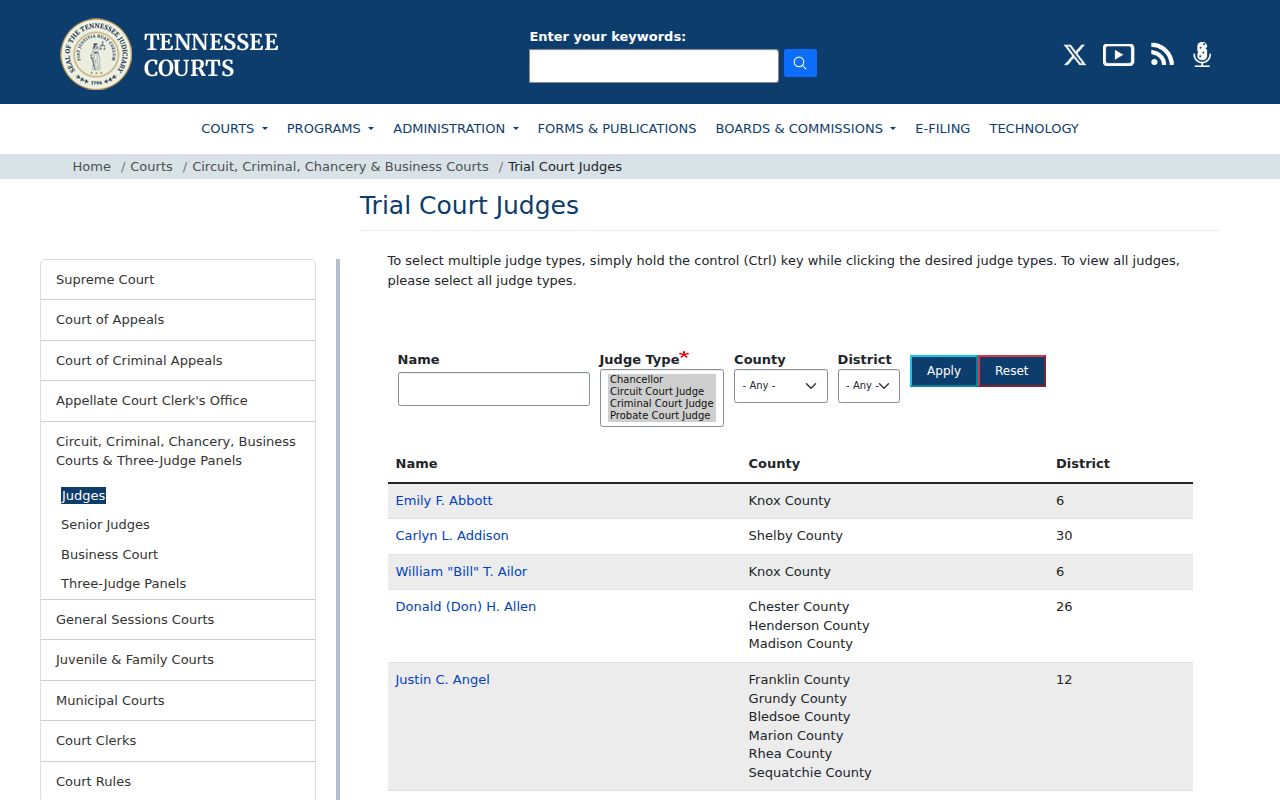
A directory settles structure, not the case. The judge and dates still come from the current docket, and the Pickett County case lookup gives more detail on local and appellate boundaries.
Sealed Dockets and Public Access
Tennessee Supreme Court Rule 34 generally opens court records to inspection. Not everything is public. Statutes, rules, protective orders, and sealing orders can still restrict a file. Juvenile records stay closed no matter who requests them. The same goes for confidential identifiers, internal judicial work, and sealed documents. Expunged entries may drop from public view entirely.
A missing case is not always sealed. It may sit in another court, an old index, or a paper file. Ask the custodian to separate an access-channel problem from a legal restriction. If access is denied, ask why. Request the legal basis and whether a redacted record can be supplied.
Key rules:
Tennessee Supreme Court Rule 34 states the court-record access framework and exceptions.
Tenn. Code Ann. § 10-7-503 supports specific requests and the response framework.